Wednesday, 25 September 2019

Tech Talk: The Importance of Pipeline Analytics in Proving Content Marketing ROI

Although the idea of content marketing is not new — 91 percent of B2B marketers use content marketing to reach their customers — marketers still struggle with defining and proving content marketing success. In fact, only 8 percent of marketers consider themselves successful in tracking content marketing ROI.

Why is that? An overwhelming majority of marketers say their biggest challenge with measuring ROI is establishing key performance indicators and having the right technology to support the measurement of those metrics.

As a result, most marketers use softer, top-of-funnel metrics such as page views and impressions to prove value — and at one time, these vanity metrics were a sufficient means of measurement. When content marketing first became a popular tactic, brands had no baseline for truly defining success, and technology limited the types of metrics marketers could track.

However, as marketers (and CMOs specifically) realized they could use content for more than just expanding brand awareness and reach — and could actually drive audiences to take a desired action — the need for more definitive metrics became stronger. Now, thanks to tools that go beyond standard site analytics, such as NewsCred’s very own Action Analytics, marketers can easily track engagement metrics such as attention, time on site, and return visitors.

The buyer journey, however, doesn’t stop there — and neither should the metrics that marketers measure. But without the proper technology, marketers are left struggling to measure that final part of the buyer journey: content’s impact on revenue. This presents a significant challenge in today’s marketing landscape, as marketers must demonstrate content ROI to both defend their budgets, and prove the value of their work (and their place on the marketing team).

But how?

How NewsCred empowers content marketers with Pipeline Analytics

At NewsCred, we believe we are in the performance era of content marketing, where content’s goal is to drive real business results and is therefore measured as a revenue driver — the need to measure and demonstrate content marketing ROI is here to stay.

And although we believe measuring the full-funnel impact of content from first-touch attribution through to closed-won revenue is critical for optimizing the entire sales cycle, we also believe the true leading indicator of content marketing success is tied directly to content-generated & content-influenced pipeline.

That’s why we’re excited to announce Pipeline Analytics — a new feature that quantifies content influenced pipeline and content-generated pipeline, so your team can easily prove the impact your work has on the marketing KPIs that matter most.
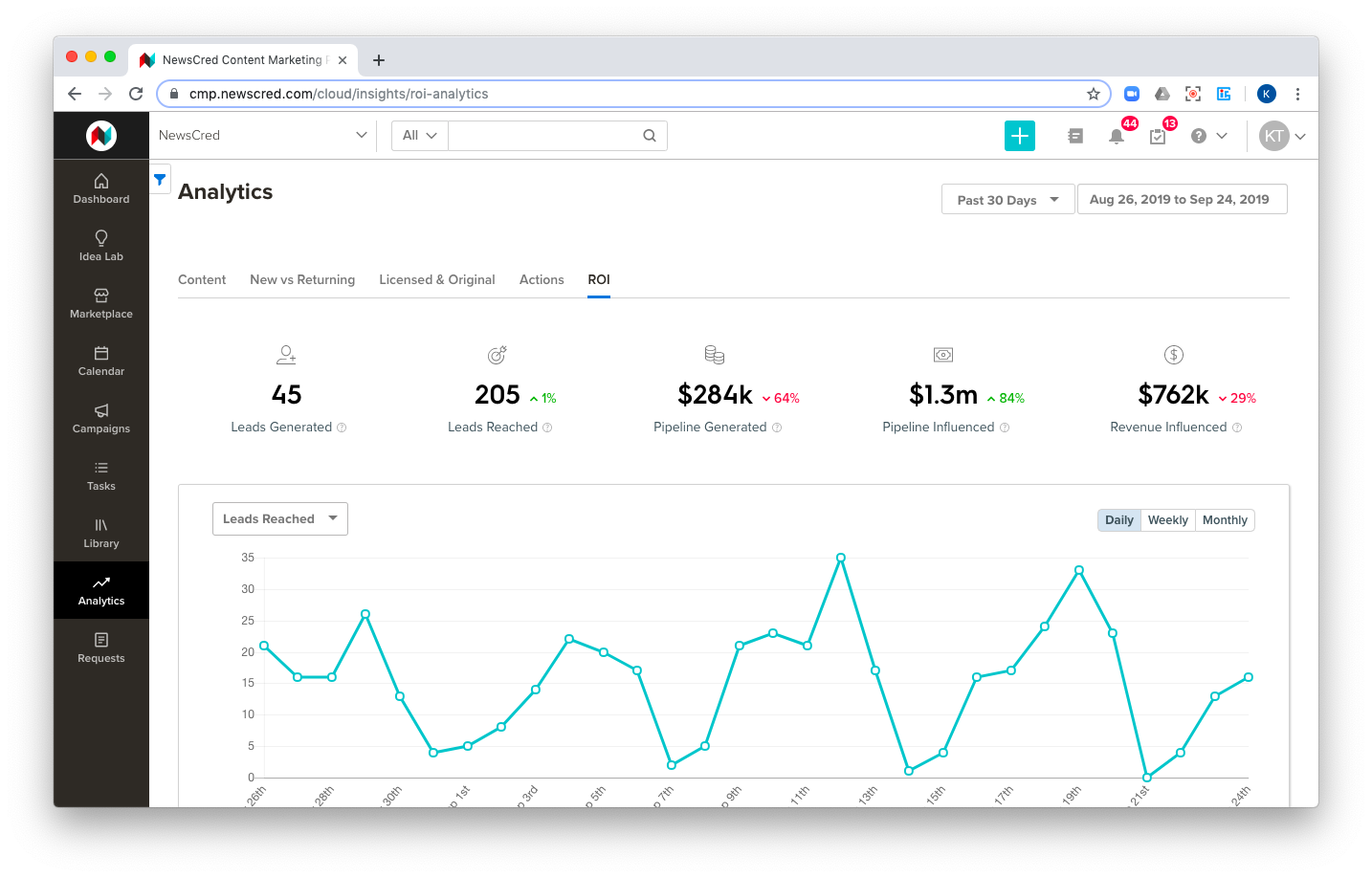
Screen Shot 2019-09-25 at 2.26.42 PM.png

With Pipeline Analytics, your team can: 

  • Measure Content-Influenced and Content-Generated Pipeline so you can attribute the impact of your content on both the number (and dollar amount) of new opportunities created for your sales team, as well as the number of open opportunities with contacts who have engaged with a piece of content. 
  • View and tailor the content journey for every contact in an opportunity. With visibility into who is consuming what content, and when, you can uncover hidden pain points and deliver the right content at the right time to help nurture prospects through the sales cycle.
  • Identify which content types, formats, and topics influenced the buyer journey to inform your strategy, optimize distribution, and create the most effective content possible.

With the addition of Pipeline Analytics to our suite of Engagement, Action, and ROI analytics, teams now have an end-to-end solution for measuring their impact on the entire customer journey, as well as optimizing their content strategy to create and deliver the most effective content possible.

But don’t take our word for it…analysts agree! 

“Without proper analytics across every stage of the content lifecycle, marketers often see a disconnect between the content they’re producing and the content that is actually making an impact,” said Christine Polewarczyk, Service Director, Content Strategy and Operations at SiriusDecisions. “Understanding the impact content has on sales pipeline and revenue creates a feedback loop for marketers to plan, create, and publish better content, ultimately increasing the efficiency and output of their teams.”

Ready to see Pipeline Analytics in action? Reach out to us for a demo!

The post Tech Talk: The Importance of Pipeline Analytics in Proving Content Marketing ROI appeared first on Insights.


source https://thebtrade.com/2019/09/25/tech-talk-the-importance-of-pipeline-analytics-in-proving-content-marketing-roi/?utm_source=rss&utm_medium=rss&utm_campaign=tech-talk-the-importance-of-pipeline-analytics-in-proving-content-marketing-roi

Tuesday, 24 September 2019

Fake Online Reviews? Here’s What You Can Do About Them.

[block]11[/block]

Online reviews are, bluntly, one of a potential customer’s best tools for choosing a company. Fake or malicious reviews can, thus, be a huge problem, requiring hours of your time spent on PR damage control rather than your core business.

When you consider that 85% of consumers trust online reviews and 84% are unable to spot fake reviews when they see them, fake online reviews can have serious consequences.

A lot of business owners feel that there is little they can do about fake reviews and that the best tactic is to ignore them.

This is not, in fact, true. It is often possible to have fake reviews removed, but there are good and bad ways to go about it.

Here are the steps you should take.

Learn to Identify Fake Online Reviews

There are a number of differences between fake online reviews and real ones.

While any one of these things may not be a problem on their own, two or more are definitely red flags:

  1. No avatar or a fake avatar. Some people are too lazy to upload an avatar. Fake reviewers are more likely to go one step further and steal their headshot. Do a reverse image search on their avatar to see if it is, for example, a famous actor or taken from some company’s board of directors page.
  2. A review history that contains repeats of the same review. If a review looks like it is copied and pasted and sent to multiple businesses, it may be a bot.
  3. A review history that contains negative reviews of most of your competitors and glowing reviews of one specific company. Some people think spamming their competition with fake bad reviews is a great way to get customers (Pro tip: It isn’t, and it’s also illegal).
  4. A large number of negative reviews in a short period of time. Again, this could be a bot. On the other hand, a large number of positive reviews on a competitor’s page in an equally short period could indicate that they are paying for reviews.
  5. Language syntax that doesn’t match the reviewer’s claimed origin, particularly people claiming to be from the US but incorrectly formatting certain things or using British spelling.
  6. Negative or hateful tone.
  7. Not having a specific reason why they are leaving a bad review.

Report Fake Online Reviews

If you suspect a review of being fake, your first task is to report the review to the site. Most sites are willing to take down obvious fake reviews, although be prepared for the fact that they may not agree that the review is fake. Yelp, on the other hand, is notorious for refusing to remove false reviews. Instead, they expect you to handle it yourself and confront your accuser. Dealing with fake reviews on Yelp, thus, relies on some different tactics.

It may take a bit of time for the review to be removed. Generally, it is not a great idea to report even very obviously fake positive reviews on the page of a direct competitor, as it may look to the review site like sour grapes or jealousy.

You can often report reviews by flagging them directly. For example, on Google, there is a small flag icon that appears when you put your cursor on the ad. Clicking on it will open a violation page and ask you to check what kind of violation type it is. You may also be able to report reviews that directly link to your competitors.

Prove Your Case

However, even when reporting fake online reviews, you need to be thorough and prove your case.

Take the time to investigate and compile the necessary evidence. Only then will your case be taken seriously and gives you the best chance of getting them removed.

Also, if you can prove a review is both untrue and malicious, you may have a case for libel against the reviewer. However, it can be very hard to track down people who leave fake reviews, and you may not be able to catch them to sue them. It is, however, often worth a try, and mentioning legal action can get sites (possibly even Yelp) to play ball on removing the ugly review.

Additionally, fake reviews are punishable by the FTC with a minimum $250,000 fine. So if you build a solid case and can demonstrate that either your competitor engaged in a negative review campaign against your business or a positive one for themselves, reporting them to the FTC can certainly improve your chances of getting justice.

Professionally Respond to Reviews

This includes fake ones while you are waiting for them to be removed. You should not argue with a reviewer, but it is perfectly fine to apologize and explain yourself. Thanking customers for good reviews can make a huge difference when it comes to getting them to come back.

One study shows that 89% of consumers read businesses’ responses to reviews. Make sure to include your business name and location in the response so that it boosts your SEO.

Most real negative reviews are not intended to be spiteful, but rather to express a legitimate grievance. When responding to negative reviews, avoid using your business name and location. Ideally, move the conversation offline.

When responding to a fake review, obviously do not do this, but emphasize your good customer service. Try doing it without getting into a fight – a proportion of people posting fake reviews are trolls who actively want a fight. You need to stay calm and rational. If you have difficulty doing so, delegate the task to the most level-headed person in the office.

Try to Drown Them in Good Reviews

man standing with hands on hips while looking at speech bubbles above him with positive comments

You can’t control whether you get good reviews. You can, however, actively encourage satisfied customers to leave a review. Most people are inclined to leave reviews only when they are not satisfied.

For online businesses, including a link to your preferred review site in a follow-up email helps. For brick and mortar, politely ask them before they leave. Make sure the link you include goes directly to your page, as you want leaving a review to be as easy as possible.

However, do not offer discounts or extras for leaving a review. It’s illegal to pay for customer reviews. If you want to give a discount to returning customers, you should give the same discount to everyone, and not have it be contingent on reviews.

Seek Professional Assistance

Remember that fake online reviews can, in fact, be an illegal attack on your business. If you need more help and advice dealing with your fake and/or bad review problem, contact LocalBizGuru today.

Download the following infographic for a quick reference on what to do about fake and bad reviews:

Illegal Reviews: How To Spot Them And Actions To Take created by Elliot Legal Group

The post Fake Online Reviews? Here’s What You Can Do About Them. appeared first on LocalBizGuru.com.


source https://thebtrade.com/2019/09/24/fake-online-reviews-heres-what-you-can-do-about-them/?utm_source=rss&utm_medium=rss&utm_campaign=fake-online-reviews-heres-what-you-can-do-about-them

How to Bring Your B2B Content Marketing Back from the Dead

Content marketing has transformed our industry, with B2B brands large and small using it to generate millions of engagements. In fact, by 2016, 88% of all B2B brands were using content marketing.

Then something changed.

Marketers produced too much. They oversaturated the market. They made it too hard to stand out.

But content stopped succeeding for a few other reasons, too.

Skimping on research: Often, marketers rushes to get their content out as quickly as possible. For example, in December 2017, more than 40,000 articles were being published about Bitcoin each week, according to Buzzsomo.

The problem is that in the rush to get content out first, organizations were skimping on research and not delivering anything truly valuable to their audience.

Remember, if someone spends their time reading content, it needs to be worth their while. Otherwise they’re unlikely to do so again.

Treating distribution as an afterthought: Organizations’ focus on content creation came at the expense of thinking through distribution.

Making content is all well and good, but effectively distributing and amplifying it is the key to getting it seen. And there’s no point producing something great if no one’s going to see it.

Failing to monitor performance: Data is at the heart of all good marketing programs. Tracking and monitoring a piece of content reveals what is and isn’t working. Without this insight, there’s no way to gauge performance, improve on what’s not working, and ensure the effectiveness of its delivery.

6 Ways To Breathe New Life Into Your Content

With that in mind, let’s turn to what can be done to improve content. Here are three steps marketers should already be taking:

  1. Know your audience: The first step to creating engaging content is understanding who the audience is and what they want. This means mapping out buyer personas and journeys before the proverbial pen hits the paper.
  2. Distribute and track: When producing any piece of content, here are three questions that must be thought through: Why is it being produced? Where is it being distributed? How is it going to be tracked? Marketers will be at an immediate disadvantage without clear answers.
  3. Match the right content to the right people: Generational differences can be found in content preferences. Younger consumers prefer video and social content, for instance, whereas older generations are more comfortable with email. Make sure you know how best to reach your audience.

Those are the basics. Now let’s look at some tips that can really kick-start your B2B content marketing:

  1. Find your niche: No matter how good your content is, if you adopt the same perspective and talk about the same topics as everyone else in your field, you may as well throw in the towel. Find a niche in your space—preferably an emerging trend that will be relevant in the next three to five years—and start creating content in that area. That way, when your topic hits the mainstream, you’ll be an established expert.
  2. Experiment and innovate: Most of the advice we’ve given so far has been about carefully planning content. But that doesn’t mean you shouldn’t experiment. Saturation is the No. 1 enemy of content marketing. Experiment with new forms of content and new channels to give yourself a better chance of standing out.
  3. Say something different: On that note, don’t be afraid to go against the grain sometimes. Doing things the way they’ve always been done is a guaranteed way to get left behind. Those who spot a new possibility, however, and dare to say something truly different will likely reap the biggest rewards.

You’re On Your Way

Content marketing isn’t going to get any easier. The market is crowded, and will presumably grow. But quality trumps quantity. So take a step back, assess what you’ve been doing, and make the necessary changes in the name of differentiation. In the end, strategically developed content will always reign supreme.

The post How to Bring Your B2B Content Marketing Back from the Dead appeared first on Marketo Marketing Blog – Best Practices and Thought Leadership.


source https://thebtrade.com/2019/09/24/how-to-bring-your-b2b-content-marketing-back-from-the-dead/?utm_source=rss&utm_medium=rss&utm_campaign=how-to-bring-your-b2b-content-marketing-back-from-the-dead

How I Ranked For 636,363 Keywords Using This Simple Hack

When I started doing SEO on NeilPatel.com I used this advanced formula
to rank for 477,000 keywords.

Over time, my traffic started to flatline and I wasn’t ranking for many more keywords, even though I was continually creating more content.

But then I figured out a simple hack that took me from
477,000 keywords to 636,363 keywords as you can see in the image above.

So, what was this hack?

Well, it’s so effective that I just updated Ubersuggest so that includes the
hack.

So how did I do it?

When someone does a Google search, what are they typically
doing? They are trying to find a solution to their problem, right?

So how can you easily identify these problems people are
searching for?

Typically, you want to look for 3 types of keyword phrases:

  1. Questions – people type in questions because they are looking for answers. And if your product or service helps answer those questions, you’ll see a boost in conversions.
  2. Comparisons – when someone is searching for comparison keywords such as “MailChimp VS Converkit” there is high buyer intent, even if your company isn’t mentioned in the search phase. (I’ll go into how to leverage this in a bit.)
  3. Prepositions – when keywords contain a preposition, they tend to be more descriptive. If you aren’t sure what a preposition is, simple prepositions are words like at, for, in, off, on, over, and under. These common prepositions can be used to describe a location, time, or place.

But how do you find these keywords?

Well, I just updated Ubersuggest to now show you questions, comparisons, and prepositions.

Just head over to Ubersuggest and type in a keyword that you want to go after. For this example, I typed in the word “marketing”.

Then as you scroll down, in the keywords ideas table you’ll see tabs for questions, prepositions, and comparisons.

I want you to click on the “view all keyword ideas”.

You’ll now be taken to the keyword ideas report that looks
like this:

Now, click on the tab labeled “questions”. It will adjust the keyword recommendations to show you all of the popular questions related to the main keyword you just researched.

You’ll then see some suggestions that you could consider
going after. Such as:

  • Why is marketing important?
  • What marketing does?
  • How marketing works?

But as you scroll down, you’ll find more specific questions such
as:

  • Why a marketing plan is important?
  • How marketing and sales work together?
  • How many marketing emails should you send?

Now that you are able to see these questions people are typing, in theory, you can easily rank for them as most of them have an SEO difficulty score of 20 or so out of a 100 (the higher the number the more competitive it is).

More importantly, though, you can create content around all of those phrases and sell people to your product or service.

For example, if you created an article on “why a marketing plan is important,” you can go into how you also can create a marketing plan. From there you can transition into describing your services on creating a marketing plan and how people can contact you if they want your help or expertise in creating one.

You can do something similar with the “how marketing and sales work together” article in which you can break down how to make each department work together. From there, you can either be an affiliate for software solutions that help merge the two departments like HubSpot or sell your own software if you offer one. You can even pitch your consulting services that help tie sales and marketing together.

And as for the “how many marketing emails should you send,” you can create content around that and have an affiliate link to popular email tools that have high deliverability and offer automation. Or you can promote your own email product.

Now imagine all of the extra keywords you can rank for by going after question-related keywords. What’s amazing about this is most of these keywords are competitive and they have extremely high search intent.

Can it get any better?

Speaking of search intent, I want you to click on the comparisons
tab.

You’ll see a list of ideas just like you did with the questions tab. But what I love doing here is typing in a competitor’s brand name here.

Let’s say I am offering an email marketing tool. I could type in “Mailchimp” and see what comparison ideas Ubersuggest comes up with.

Now for this example, I want you to imagine that you have an email company called Drip and Drip isn’t really mentioned in any of these keyword comparison ideas.

What’ll you want to do is create articles on all of the popular comparison terms like “Mailchimp vs Constant Contact” or “Mailchimp vs Convertkit” and within those articles break down the differences and also compare them with your own tool Drip.

Be honest when writing the comparisons. Show off which is the best solution using facts and data and break down how you are different and in what ways your own solution is better than the two solutions the reader is comparing.

This will bring awareness to your solution and you’ll find
that people will start purchasing it even though they were comparing two of
your competitors.

If you want a good example of how to create a neutral
comparison type of blog post, check out this article
comparing web hosts.

And if you want to take it one step further, you can click on the “prepositions” tab to find even more ideas.

Sticking with the Mailchimp example, you can see that people are curious about Shopify and WordPress integrations.

You can write articles related to integrations and also push your own product and break down how it differs from the others.

If you want to take it one level deeper, it will give you ideas on how to modify your business. For example, if I created an email marketing tool, I would create a Shopify, WordPress, Woocomerce, and Squarespace integration based on the ideas I got from the prepositions tab.

So how did I rank for 636,363 keywords?

I didn’t use all of the examples above on NeilPatel.com because I am not really trying to sell a product and I don’t have the time to write thousands of new blog posts.

But I did type in my domain name into Ubersuggest and then headed over to the top pages report.

From there I looked at the pages that are already ranking well on Google and clicked on the “view all” button to see the exact keywords each page ranks for.

As you can see from that page I rank for questions like “what
is affiliate marketing” as well as popular prepositions and comparisons.

How did I do this?

Well, that top pages report shows you keywords each of your pages already ranks for. So all you have to do is research each of those terms through Ubersuggest and find popular questions, prepositions, and comparisons.

Conclusion

The natural instinct for any SEO or marketer is to rank for
popular terms that have a lot of search traffic.

But there is an issue with that strategy. It takes a lot of time, it’s extremely competitive, and many of those search phrases don’t cause a ton of conversions as they are super generic.

So, what should you do instead?

Focus on solving people’s problems. The way you do this is by creating content around the questions, prepositions, and comparisons people are searching for in Google.

What do you think about the new Ubersuggest feature?

The post How I Ranked For 636,363 Keywords Using This Simple Hack appeared first on Neil Patel.


source https://thebtrade.com/2019/09/24/how-i-ranked-for-636363-keywords-using-this-simple-hack/?utm_source=rss&utm_medium=rss&utm_campaign=how-i-ranked-for-636363-keywords-using-this-simple-hack

How to Survive and Thrive in a Clickless World

Recent data has revealed that less than 50% of Google searches result in a click.

That means over half of Google’s search engine results lead to no clicks through to websites or properties that aren’t owned by Google.

Google no click results1

This data was attained via Clickstream and first analysed by SparkToro.  

Why are fewer people clicking from the SERPs?

This Google organic search trend milestone has been caused by a number of factors:

  • An increase in search engine results page (SERP) features that pull information from external websites directly into Google’s search results. E.g. featured snippets and People Also Ask boxes.
  • Google related properties and features appearing for an increasing number of verticals (Google Flights, Google Maps, YouTube etc.)
  • Ongoing changes to the SERP design, directing more traffic towards paid advertisements

How does this impact my website?

Fewer searches resulting in clicks could mean fewer website visits. This could lead to a decrease in organic traffic, despite an increase in organic visibility or ranking position.

Measuring the performance of a site will be impacted, as traffic and conversions have traditionally relied on users moving from the SERPS to a site.

The extent to which this impacts traffic and conversion is highly dependent on vertical, however, as Google continues to expand its reach, there are lessons that can be learnt for SEO strategy moving forward.

What can we do about this?

With fewer clicks available than before, the organic landscape is more competitive than ever. But organic search still represents a significant opportunity. There are several things that can be done to make sure a website not only survives, but thrives in this new search environment:

  1. Optimise for Google’s SERP features

While some search results may lead to no clicks, being present in the SERP can have other benefits, like brand visibility and keeping your website at the forefront of a searcher’s mind. Crucially, optimising a site for Google features also means that competitors are not taking advantage of the same opportunities.

When investigating which SERP features to target, it’s important to prioritise. A site may choose to focus only on keywords that have a high click through rate (CTR), or may go after increasing visibility rather than clicks; optimising for features even if it results in a reduced CTR from that SERP. Be aware of the landscape and make informed decisions.

  1. Optimise content for Google-owned properties

Making sure a website is in a position to capitalise on traffic from Google-owned properties will help a brand stay visible, even if organic clicks are reduced. For example, a travel company may want to ensure they’re included in Google Flights. And websites with a physical location will want to be optimised for Google’s Local Pack.

  1. Optimise for search journeys

Searches rarely occur in silos; so even if one search results in no clicks, a future search may drive a visit. Ensuring that a website is set up to answer a user’s need at every stage of the search journey will give it the best chance of driving qualified leads.

It’s not enough to just offer a product as the organic search environment gets increasingly competitive and dominated by Google itself.

  1. Continue to build content that places users at the centre of a website experience

Organic search is often a significant part of any marketing campaign; however, SEO is not a silver bullet. Building a product and an experience that customers love is crucial to keep people coming back.

It’s worth noting that Google is currently being investigated by the US Department of Justice over antitrust claims relating to its search results. While we would never recommend relying on external factors like this, it’s worth noting that discussions are ongoing.

Should we target other search engines if Google results are resulting in fewer clicks?

Many SEO campaigns focus attention primarily on optimising for Google.

Despite Google offering fewer clicks from its search results than ever before, it’s still the largest search engine by a significant margin. This means that small gains in Google are equivalent to large increases in smaller search engines.

Search_Engine_Market_Share.png

Google is at the forefront of search engine technology, with other search engines often playing catch-up. Optimising for Google will future-proof a website.


This article was written by Dan Cartland from The Drum and was legally licensed through the NewsCred publisher network. Please direct all licensing questions to legal@newscred.com.

The post How to Survive and Thrive in a Clickless World appeared first on Insights.


source https://thebtrade.com/2019/09/24/how-to-survive-and-thrive-in-a-clickless-world/?utm_source=rss&utm_medium=rss&utm_campaign=how-to-survive-and-thrive-in-a-clickless-world

Friday, 20 September 2019

I Started a New Job and Had the Best First Day

Editor’s note: This article was originally published on Medium.com. It is authored by one of our talented, new employees.


I’m proud of the work I’ve done in advocating and normalizing my gender identity at work. I’ve lived my truth in the most public of ways, including at customer workshops, sales pitches, conferences, and speaking engagements. I’ve cultivated a network of colleagues, customers, leaders, and friends that I’m deeply proud of. The grueling, exhausting dual role of my day job and gender identity 101 educator has led me to the best first day.

I was terrified to find a new job. My company was in the midst of an acquisition. I was being congratulated left and right, and yet I knew I couldn’t stay.

I wanted to find something different, but I felt paralyzed. As a transmasculine non-binary human, I knew that any job transition was going to require tremendous emotional labor and vulnerability to not only constantly come out in interviews, but to also advocate for the role, company, and culture I know I need to be successful.

I’m now 21 days on the other side of that paralyzing fear, and I feel energized and grateful. I’m in a senior leadership role, working with a talented and motivated team on trailblazing work that allows me to be…me.

I had a good hunch that I could be both myself and be respected when I came into the office for my final interview. Without even having to ask, my correct pronouns were used and I was offered a gender-neutral restroom. These small gestures had me cautiously hopeful that I was landing in an affirming and safe work environment.

As I was filling out the requisite first-day paperwork, I had my first “best day” moment. There, on the first page of my benefits enrollment paperwork, I saw it. Casually placed after “Male” and “Female,” I was able to effortlessly and easily select my gender as “Non-binary.” This is a big deal. It’s the first time I’ve been able to accurately indicate my gender marker on employment paperwork, and I didn’t even have to ask for it. This is the first new beginning where I didn’t carry the emotional burden of owning my presence in a professional dynamic.

I’ve had my pronouns on my LinkedIn profile and in my email signatures for years, but it felt like no one noticed or cared. I was often misgendered in workshops, emails and/or meetings, with my own senior leadership team members, as well as customers and colleagues. But this company is different. I’ve never explicitly shared my pronouns with anyone here … they simply did their research and are leaning on the company values to facilitate a positive and inspiring culture (for everyone).

I feel so cared for and seen by my leadership team and colleagues because I don’t have to do the work alone. The entire experience has been new and different, and it’s offered me a valuable opportunity to reflect on how I’ve gotten to this point in my life.

It’s liberating and powerful to finally feel seen. I feel more connected, valued and inspired. I’m experiencing the long-tail effects of my many years of work, and all I can think about is this Ayesha Siddiqi quote, “Be the person you needed when you were younger.” Starting this new job with such ease and kindness ignites even more passion for gender identity activism.

Carter.png

You don’t have to be in a leadership position or fill a People Ops role in order to create a best first day like mine. Start with fostering an environment of inclusion and communication through modeling (like adding your pronouns to your email signature or LinkedIn Profile), ask your People Ops team to make gender identity resources widely accessible, support professional development that nurtures diversity and inclusion, consider adding more inclusive messaging on your website and/or job postings, and make sure your office signage welcomes everyone.


Carter Stepanovsky is the VP of Platform Strategy at NewsCred.

The post I Started a New Job and Had the Best First Day appeared first on Insights.


source https://thebtrade.com/2019/09/20/i-started-a-new-job-and-had-the-best-first-day/?utm_source=rss&utm_medium=rss&utm_campaign=i-started-a-new-job-and-had-the-best-first-day

Thursday, 19 September 2019

How Should Brands Measure Success On Instagram If ‘Likes’ Are No Longer Relevant?

You have probably heard the news. In July, Instagram announced their test of hiding “likes” on posts just expanded to more markets around the globe, including Australia. Instagram says the reason for the new feature is to have users concentrate on their posts and interacting with the app, rather than likes.

However, the big question is, how will this affect a business that is purely built on social media marketing and relies on social proof? Our first thought – a massive change for the business.

Likes are one of the most recognizable elements of social proof, and a core element to engagement metrics of a brands’ social platforms. If not engagement, what social metric will drive business results at top? Nonetheless – the new era is here, and we believe it will be defined by personalized content. 

More than just a like

At first, social media was a new way people used to connect. Over time, people started to rely on social media platforms more and more. As a result, business owners started to take advantage of the data to understand a specific audience to create strategies to market their products on social media. Today, social media has become one of the most important aspects of digital marketing.

When you think about successful social media content, you are probably already thinking of the generic metrics like the number of likes you get. The number of likes a post receives helps brands to determine how engaged their followers are, what works and what doesn’t.

Yes, the number of double-taps can be considered as an acknowledgement. However, today’s social media users want to interact with brands on a more personalized level, which includes much more than just a like.

Opportunity from customers

For us, the biggest marketing channel has always been social media. When we first started out, we saw the opportunity from customers, and how we could connect with them immediately through social media. Ever since then, we have been constantly engaging with and listening to our customers on social media to create content they love and want to share. By engaging with our customers, we saw what was working through views, likes and audience reach.

Now that Instagram has launched their newest prototype, brands need to think differently to stand out and position themselves in the ever-changing competitive environment. This is where personalized content comes into play. In the digital marketing space, personalization is critical when it comes to capturing the attention of your audience.

Today, consumers want to interact with brands on a more personal level and be treated as individuals. Content that is meaningful for your audience can help build social engagement, which can result in customers becoming brand advocates.

A community on social

We believe we have cracked the code to set ourselves from other retailers. At Supernova, we give back power to the creators by allowing them to work directly with their customers; with the help of our community on Instagram as the deciding voice.

A community is where the sharing, influencing and passing on information starts. By creating social communities, we can talk with our audience to ensure that they stay engaged and trusts our brand.

However, identifying and developing a community on social media start with creating personalized content. As retailers, we have seen that consumers are growing increasingly accustomed to personalized content. This means that it is more important than ever for brands to provide personalized content.

At Supernova, we see opportunities in the whole movement of social media influencers. Brands are lining up to be associated with popular social media accounts, and this high demand has created a whole industry of its own. Influencers are people who have a passion and aren’t afraid to tell the world about it, and they are becoming more and more sophisticated.

Their strength is in creating content, and the better content they can create, the more working together with a brand makes sense because they can create something consumers would like to engage with. We like how everything on the Internet is customisable and delivers the content our customers are interested in.

Now, as the new era on Instagram has arrived, brands and influencers need to work even harder to deliver stronger content.

In a world without “likes”, influencers would be pushed to create not only better content, but more diverse types of content such as videos and Instagram “stories”. We believe this change can result in a stronger engagement between influencers and their followers, as it could cause more reading of captions and more thoughtful content, in addition to the photos.

Get to know your audience

Social media personalization isn’t only about your content, but also the way you communicate with your audience. Supernova’s business model is proof that success comes when it is based on collaboration with your customers. To truly make our audience feel connected to our brand, we have to directly communicate with them to find out what their needs are.

What type of content do they want to see? How do they feel connected to our brand? In return, we know if we’ve hit the nail on the head, and will move forward, acknowledging and taking on all the feedback. We are also using social media to test brand and product names, as well as price.

The result – all our brand names have been chosen by our customers. Sand & Sky, for example, was originally called Rose Beach, but we couldn’t get the URL, so our customers voted for the second choice, Sand & Sky. Instagram’s new era means we as brands maker, will have to invest more time, money and effort to get to know their audience on a deeper personal level, to further create content that grabs their attention. Furthermore, pair that with the right strategy to reach the right audience; that’s what will earn brands the best return on their social investment.

Having no likes will force the businesses to measure what actually matters: value, relevance and impact. This will most likely force brands to take time to build a community and not just fans.

Emily Hamilton and Sarah Hamilton are the co-founder and managing director at Supernova, respectively.


This article was written by Sarah Hamilton and Emily from The Drum and was legally licensed through the NewsCred publisher network. Please direct all licensing questions to legal@newscred.com.

The post How Should Brands Measure Success On Instagram If ‘Likes’ Are No Longer Relevant? appeared first on Insights.


source https://thebtrade.com/2019/09/19/how-should-brands-measure-success-on-instagram-if-likes-are-no-longer-relevant/?utm_source=rss&utm_medium=rss&utm_campaign=how-should-brands-measure-success-on-instagram-if-likes-are-no-longer-relevant